Water Green Mountain Blue
UK
US
CN
" Water Green Mountain Blue " ( 水碧山青 - 【 shuǐ bì shān qīng 】 ): Meaning " Why Do Chinese Speakers Say "Water Green Mountain Blue"?
It’s not a mistranslation—it’s a grammatical sigh of relief. In Chinese, adjectives like *qīng* (blue-green) and *lǜ* (green) function as sta "
Paraphrase
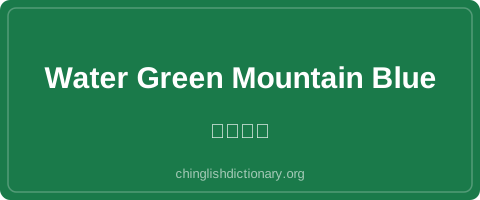
Why Do Chinese Speakers Say "Water Green Mountain Blue"?
It’s not a mistranslation—it’s a grammatical sigh of relief. In Chinese, adjectives like *qīng* (blue-green) and *lǜ* (green) function as stative verbs, so “green mountain, blue water” isn’t descriptive decoration—it’s a compact, parallel declaration of state: *the mountain is green; the water is green-blue*. English demands nouns + modifiers (“green mountains and blue waters”), but Chinese stacks bare nouns with attributive adjectives in fixed, poetic order—no “is”, no “and”, no article. That economy becomes charmingly stark when lifted whole into English, like hearing a haiku recited as inventory.Example Sentences
- At the entrance to Huangshan’s eastern gate, a hand-painted sign reads “Water Green Mountain Blue”—(“Lush green mountains and crystal-clear waters”)—to a native English ear, it sounds like a Zen riddle whispered by a botanist who forgot his articles.
- When the tour guide points to the Li River near Yangshuo and says, “Look! Water Green Mountain Blue!”—(“Look at these emerald hills and jade-green waters!”)—the phrase lands like a gentle linguistic hiccup: vivid, rhythmic, but missing the glue words that hold English descriptions together.
- A souvenir shop in Guilin sells tea tins stamped with “Water Green Mountain Blue” beside a misty ink painting—(“Scenic natural beauty”)—and the Chinglish version feels less like an error than a distilled essence: no verb, no preposition, just two truths placed side by side like stones in a scholar’s garden.
Origin
The phrase comes from *qīng shān lǜ shuǐ*, where *qīng* carries layered meaning—it’s not just “blue” but the deep, cool hue of unspoiled nature: bamboo shadows, distant peaks, river depths. Classical Chinese poetry favored this four-character parallel structure (*chengyu*-adjacent but not quite one), pairing nouns with their inherent qualities as inseparable units. It reflects a worldview where landscape isn’t scenery to be observed, but a living system in balanced harmony—so “mountain” and “water” aren’t objects modified by color, but entities whose very being *is* greenness and blueness. The grammar doesn’t subordinate description to noun; it fuses them.Usage Notes
You’ll find “Water Green Mountain Blue” most often on eco-tourism signage, provincial environmental campaign posters, and ceramic wares sold at heritage villages—not in corporate brochures or government white papers. Surprisingly, it’s gained quiet traction among young Chinese designers who reprint it ironically on tote bags and enamel pins, reclaiming its starkness as minimalist branding. And here’s the twist: some rural tourism boards now use the English phrase *intentionally*, knowing foreign visitors associate its odd syntax with authenticity—proof that what begins as grammatical necessity can, over time, become cultural shorthand with its own quiet authority.
0
collect
Disclaimer: The content of this article is spontaneously contributed by Internet users, and the views of this article are only on behalf of the author himself. This site only provides information storage space services, does not own ownership, and does not bear relevant legal responsibilities. If you find any suspected plagiarism infringement/illegal content on this site, please send an email towelljiande@gmail.comOnce the report is verified, this site will be deleted immediately.